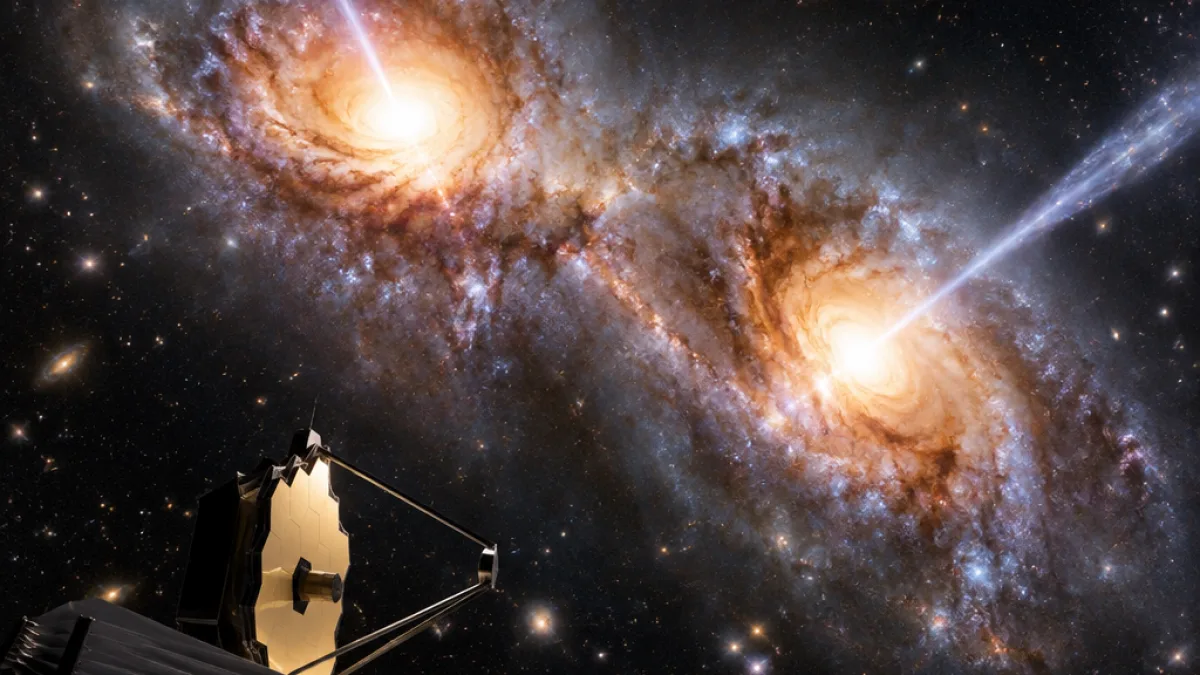
Astronomers have identified the most distant and oldest compact pair of quasars yet observed, finding two rapidly growing supermassive black holes that were already shining about 900 million years after the Big Bang. The discovery offers a demanding test for theories about how the universe’s earliest black holes and galaxies became so massive so quickly.
The system is officially designated J1602+4228AB and has been given the nickname Nāpōwawāʻenakaulua. Observations from NASA’s James Webb Space Telescope and the Gemini North Telescope in Hawaiʻi showed that the two quasars are separated by roughly 18,100 light-years—about one-fifth of the Milky Way’s diameter.
A system from the universe’s cosmic dawn
Quasars are powered by supermassive black holes feeding on gas and dust. As that material falls inward, it releases vast amounts of energy, allowing the objects to outshine the galaxies around them. In this newly studied pair, one black hole has a mass of about 1.5 billion times that of the Sun, while the other is estimated at about 400 million solar masses.
The objects existed during the period known as the universe’s “cosmic dawn,” when the first stars, galaxies and black holes were forming. Because light takes time to travel, observations of the system show astronomers what it looked like at that early stage rather than how it appears in the present-day universe.
“There is no definitive theoretical explanation for how a single one of these giant quasars exists so early in the age of our Universe, much less two,” Silvia Onorato, the study’s lead author, said.
The findings were published in The Astrophysical Journal Letters. They add to a growing set of observations suggesting that some early black holes and galaxies accumulated mass at a faster rate than existing models had expected. The close pairing makes the result especially difficult to explain: astronomers must account not only for the rapid growth of each black hole, but also for the presence of two enormous quasars in the same relatively small region.
What the observations establish
- System: J1602+4228AB, nicknamed Nāpōwawāʻenakaulua
- Distance in cosmic time: about 900 million years after the Big Bang
- Separation: approximately 18,100 light-years
- Black-hole masses: about 1.5 billion and 400 million solar masses
- Instruments: the James Webb Space Telescope and Gemini North Telescope
The pair was first identified through the Aether Survey, a James Webb Space Telescope program designed to catalog objects in the early universe. The survey examined around 200 quasars, representing nearly half of all quasars currently known, according to the report.
The result does not by itself provide a complete formation history for the system. Instead, it expands the number of early-universe observations that theories must explain. Onorato said the black holes were observed when the universe was only about a thirteenth of its current age, yet their masses were comparable to those of supermassive black holes seen today. That comparison highlights the central scientific problem: the universe appears to have produced at least some giant black holes much earlier than conventional growth timelines easily allow.