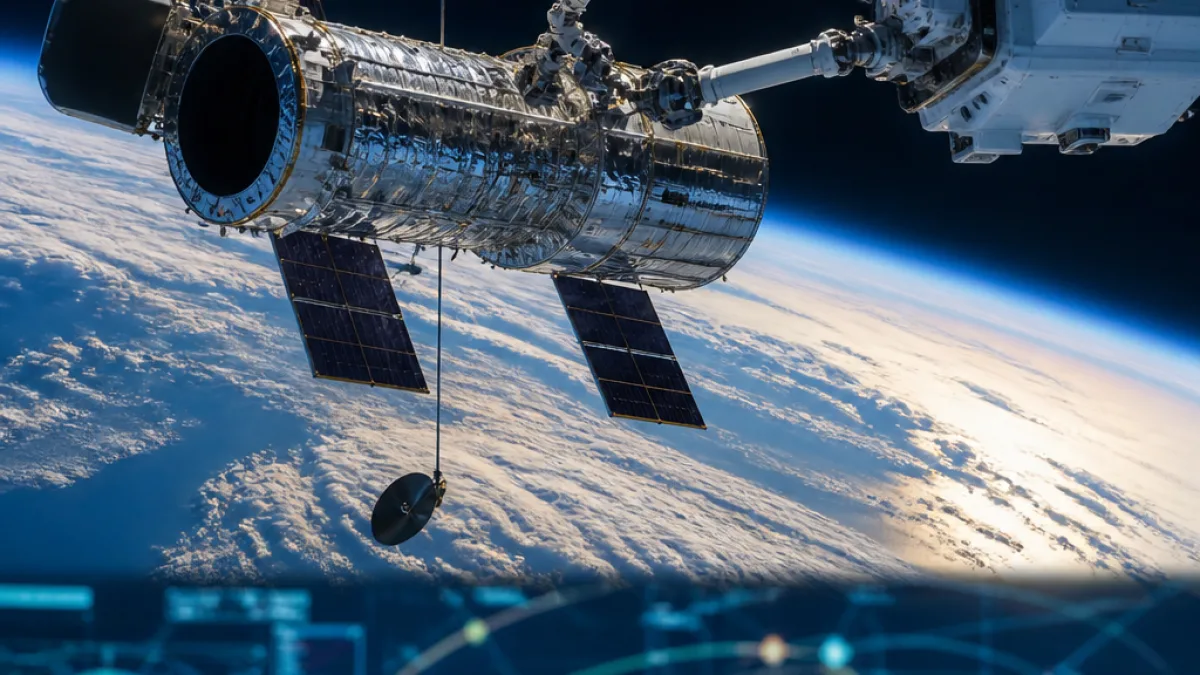
NASA is seeking information from commercial space companies about a possible mission to service the Hubble Space Telescope, raise its orbit or guide the veteran observatory through a controlled reentry. The agency’s request is not an award or a final decision to proceed, but it signals that NASA is examining options as the telescope’s orbital lifetime becomes less certain.
Hubble has been maintained by NASA astronauts on Space Shuttle missions, but the last servicing flight, STS-125, launched on May 11, 2009. Scientists had expected that mission to extend the observatory’s operating life by about five years. Nearly 17 years later, Hubble is still producing scientific observations, according to NASA, while no direct replacement is expected before the 2040s.
A narrowing window for intervention
Unlike spacecraft equipped with propulsion systems, Hubble cannot steer itself into a higher orbit or control the timing and location of its eventual descent. NASA estimates a 10% chance of atmospheric reentry by September 2032, rising to 50% by December 2033. The agency has also noted that increased solar activity can increase atmospheric drag, potentially changing the timetable.
Because Hubble is a large spacecraft, an uncontrolled reentry would carry a remote possibility that debris could reach the ground. NASA’s information request therefore considers a vehicle that could grapple the observatory and direct it toward a controlled disposal. Other concepts would instead preserve the telescope’s usefulness by changing its orbit or extending its time in space.
“enhance its ongoing performance and increase its resilience and expected on-orbit lifetime.”
That language appears in NASA’s description of one possible approach. Another option would lift Hubble’s orbit to at least 600 kilometers. A servicing or orbit-raising mission would have to be designed around an aging observatory and conducted within NASA’s stated requirement for a mission by 2032.
Hubble remains in demand
The possible loss of Hubble would affect more than the history of space exploration. NASA reports that demand for observing time remains high, with proposals exceeding available capacity by a ratio of 7 to 1. The telescope’s continued use also comes as newer observatories take on different scientific roles: the James Webb Space Telescope and the Nancy Roman Space Telescope are not presented as immediate replacements for every function Hubble provides.
Before becoming NASA administrator, Jared Isaacman advocated a SpaceX mission to raise Hubble’s orbit, but that proposal was ultimately rejected. NASA’s current notice leaves open the possibility that a similar commercial concept, or another approach, could be considered. The immediate purpose of the request is to gather information from industry rather than announce a selected provider or a funded flight.
- Servicing: A commercial vehicle could potentially rendezvous with and work on Hubble.
- Orbit raising: One concept would move the observatory to an orbit of at least 600 kilometers.
- Controlled disposal: A spacecraft could guide Hubble through a planned reentry instead of leaving the descent uncontrolled.
NASA’s inquiry reflects a practical constraint of the space telescope era: Hubble remains scientifically valuable, but its future depends on orbital mechanics, spacecraft condition and the availability of a safe intervention. Until NASA selects an approach, the observatory continues operating while the agency evaluates whether commercial space capabilities can extend its mission or manage its eventual end.