
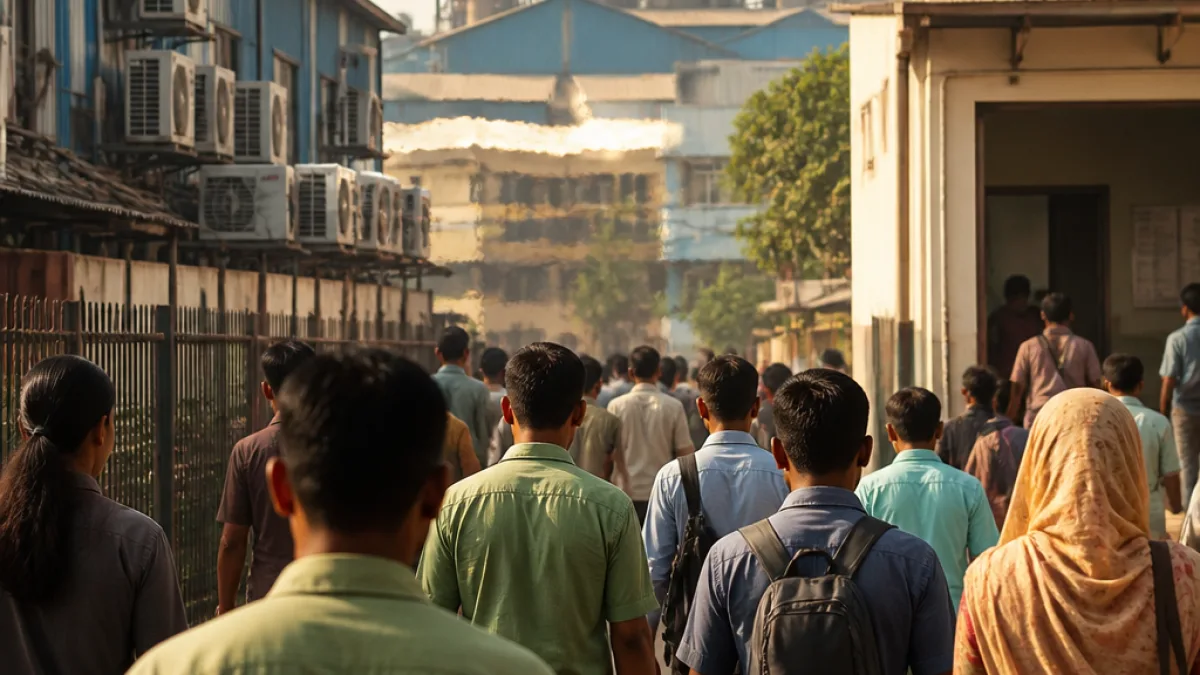
Climate-sensitive health risks cost Bangladesh an estimated $20.7 billion a year, according to a report released October 29 by the Knowledge Hub Institute, or KHI. The figure is equivalent to 4.6% of the country’s gross domestic product in 2024, underscoring how rising temperatures and other climate-related hazards are affecting public health and economic activity.
The report, titled “Multi-Dimensional Health Impacts of Climate Change in Bangladesh: Pathways, Costs and Policy Implications,” examines the financial effects of heat, infectious diseases, disasters and air pollution. Its broader estimate includes risks associated with climate-sensitive hazards, while the researchers put the portion directly linked to observed warming at between $1 billion and $3.3 billion annually.
Heat accounts for most of the measured cost
Heat exposure was the largest contributor in the KHI analysis. Bangladesh lost approximately 29.3 billion potential working hours in 2024 because of heat, producing an estimated economic loss of $15.8 billion. Farmers and other agricultural workers represented nearly two-thirds of those lost hours, according to the report.
The assessment also links high temperatures to serious health effects. Modelled estimates cited by KHI associate heat with approximately 16,000 deaths in 2023. Research reviewed for the report found that very hot days were also associated with increased levels of diarrhea and heat exhaustion.
| Measure | Estimate |
|---|---|
| Total annual climate-sensitive health burden | $20.7 billion |
| Share of 2024 GDP | 4.6% |
| Annual loss linked specifically to observed warming | $1 billion to $3.3 billion |
| Economic loss from heat-related lost work hours in 2024 | $15.8 billion |
Hotter conditions are becoming more common
KHI analyzed weather records from eight divisional headquarters and found that the number of days reaching at least 36°C roughly doubled between the 2000s and the 2020s. The report also examined links between warmer conditions and diseases including dengue, along with waterborne illness, air pollution and the effects of disasters on health and medical services.
The report said Bangladesh is not adequately prepared for the growing risks. It identified limited public spending, weak execution of climate-related health programs and the absence of a dedicated national heat-health action plan as key gaps. The country also lacks a systematic way to record heat-related illnesses and deaths, making the health burden harder to measure and address.
- Heat exposure: $15.8 billion in estimated losses from reduced working hours in 2024.
- Workforce impact: 29.3 billion potential working hours lost, with agricultural workers accounting for nearly two-thirds.
- Health impact: approximately 16,000 modeled deaths associated with high temperatures in 2023.
At the report’s release event at BRAC Centre in Dhaka, State Minister MA Muhit described rising heat and humidity as major public-health concerns and called for coordinated action. The KHI findings place that concern in economic terms: the largest component of the estimated burden came not only from treating illness, but also from lost productive time in a workforce heavily exposed to outdoor heat.