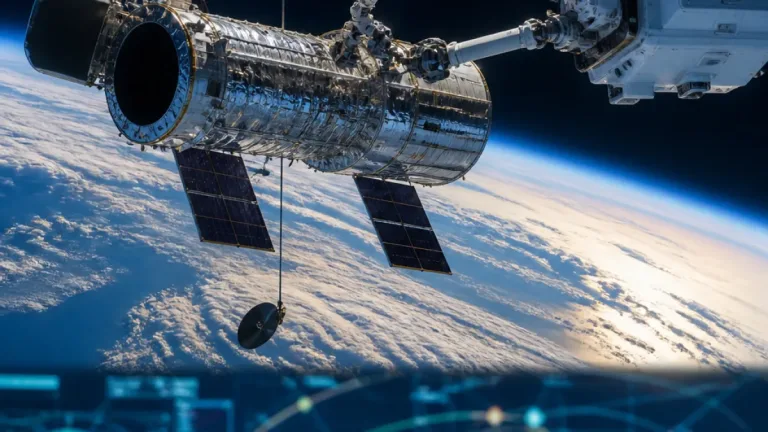
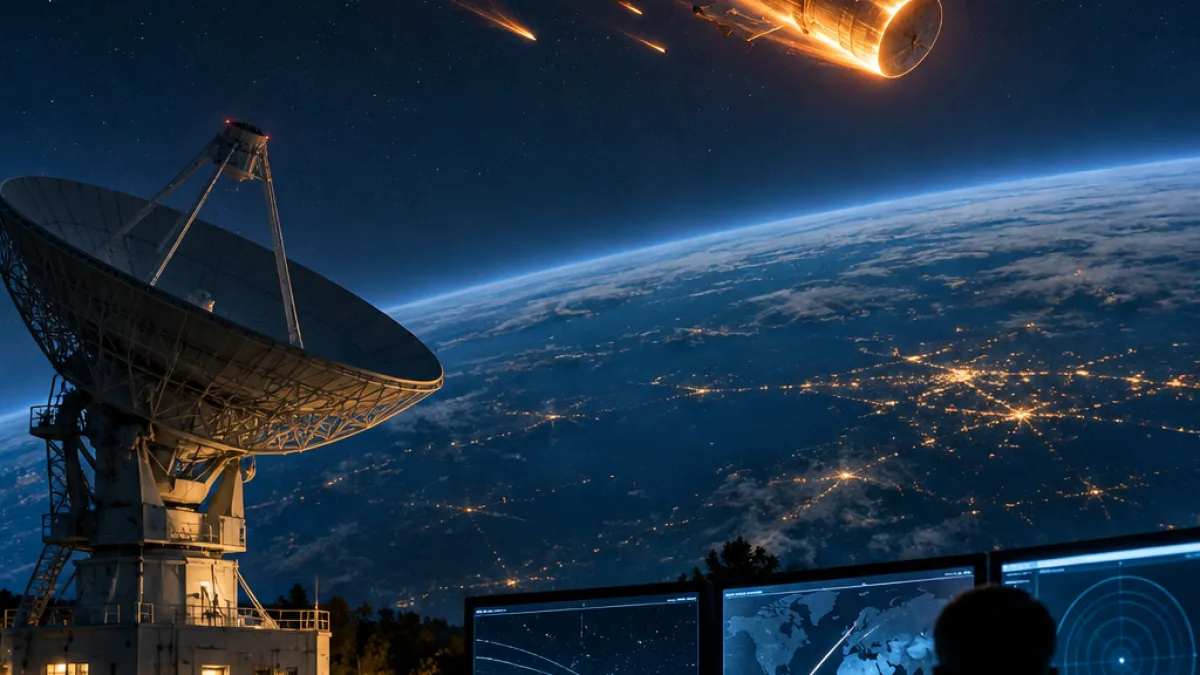
NASA’s Neil Gehrels Swift observatory is nearing the end of its mission, with reentry into Earth’s atmosphere expected at 3:30 a.m. EST on November 4. The agency said some fragments from the spacecraft could survive the descent, making the observatory’s retirement a matter of both scientific significance and public-safety monitoring.
The spacecraft weighs about 3,200 pounds. NASA calculated the potential risk of harm to an individual from surviving debris at 1 in 2,100, according to Aviation Week. The figure describes the agency’s assessment of the reentry hazard; it does not indicate that debris is expected to strike a particular location or person.
A mission built around powerful cosmic explosions
Swift was launched in 2004 to investigate gamma-ray bursts, brief emissions of extremely high-energy light associated with some of the universe’s most violent events. During nearly 22 years in orbit, the observatory also contributed to research on supernovae, active galaxies and stars being torn apart by black holes.
The observatory’s work produced a substantial record of observations. It detected more than 2,000 gamma-ray bursts and captured more than 1.5 million images, according to NASA. Those observations helped scientists study events that can change rapidly and are difficult to investigate with instruments on the ground.
Why the spacecraft is coming down
Swift operated in low-Earth orbit, where atmospheric drag gradually reduces a satellite’s altitude. The spacecraft did not have a propulsion system capable of regularly raising its orbit, so its descent eventually became unavoidable. NASA has concluded operations as preparations for reentry proceed.
The reentry marks the physical end of a mission that was originally intended to last only two years but continued for decades. The main stages of the observatory’s retirement are:
- Mission status: NASA has concluded Swift’s operations.
- Expected reentry: 3:30 a.m. EST on November 4.
- Spacecraft mass: about 3,200 pounds.
- Debris assessment: NASA expects some fragments to survive reentry.
NASA’s assessment places the event within the broader challenge of managing aging spacecraft in low-Earth orbit. Without a propulsion system to offset atmospheric drag, Swift’s orbit continued to decay after years of scientific service. Most of the spacecraft is expected to burn up as it passes through the atmosphere, while the agency’s calculated risk accounts for the possibility that some material will reach the ground.