Four crew members have emerged from a 378-day isolation mission at NASA’s Johnson Space Center in Houston, completing an extended simulation designed to study the practical demands of a future human expedition to Mars.
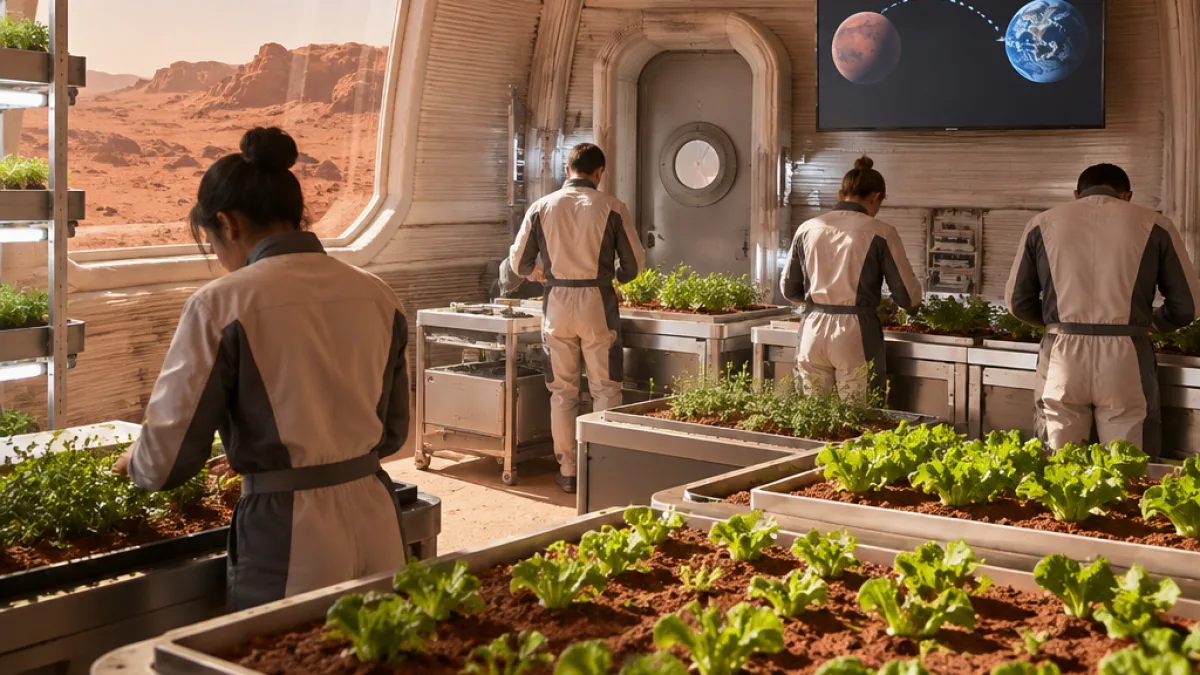
The volunteers lived inside a 1,700-square-foot, 3D-printed habitat as part of NASA’s Crew Health and Performance Exploration Analog, or CHAPEA, program. They entered the facility on October 19, 2025, and left it on Saturday after spending more than a year operating under conditions intended to resemble some of the constraints of a mission to another planet.
A year inside a simulated Mars habitat
The crew carried out daily tasks that included cultivating crops in simulated Martian soil. They also communicated with NASA officials using delays designed to replicate the time required for signals to travel between Earth and Mars. Those delays remove the possibility of the rapid back-and-forth communication available during missions in low Earth orbit or on the International Space Station.
NASA said the program is intended to provide insight into how astronauts adapt to the routines and pressures of long-duration missions beyond Earth while remaining healthy and productive. The exercise is a ground-based analog rather than a Mars expedition: the participants remained at Johnson Space Center, and the habitat recreated selected operational constraints rather than the full environment of the Martian surface.
“It's been a hell of a year - analog astronauts living in captivity of our own free will,” Ellen Ellis, the mission’s medical officer, said after the crew emerged at Johnson Space Center.
The other participants were mission commander Ross Elder, science officer Matthew Montgomery and flight engineer James Spicer. Their work was structured around the kinds of sustained routines that would be required when a crew could not quickly return to Earth or rely on immediate assistance from mission control.
NASA’s longer-term exploration plans
NASA has used robotic rovers and orbiting spacecraft to explore Mars, while its human-exploration plans call for a possible crewed mission to the planet as early as the 2030s. Before that, the agency plans to return astronauts to the moon for the first time since 1972. The lunar effort is intended to precede or support broader ambitions for human activity beyond Earth, according to the mission account.
Ellis referred after the isolation period to plans for a lunar base and to a space-related service academy pursued by President Donald Trump’s administration. She also tied the program to the economic and strategic importance of maintaining U.S. capabilities in space.
“Let's seize the initiative, lead with science that will benefit our economy and ensure our legacy in space for our children's children,” Ellis said.
Elder said the mission’s long-term objective remained difficult but achievable. His remarks described the value of testing how crews work through isolation, delayed communication and demanding routines before attempting an actual interplanetary mission.
The four crew members are scheduled to spend two weeks in post-mission evaluations and debriefings with NASA scientists. Those assessments will allow researchers to examine the experience after the habitat phase and gather further information about the effects of the simulated conditions.
- Mission length: 378 days in isolation
- Facility: 1,700-square-foot 3D-printed habitat at Johnson Space Center
- Participants: Ellen Ellis, Ross Elder, Matthew Montgomery and James Spicer
- Next phase: Two weeks of evaluations and debriefings with NASA scientists
The mission cannot establish that a crew is ready for Mars, where radiation, reduced gravity, a hostile surface environment and the distance from Earth would introduce challenges not reproduced by the habitat. Its value lies in the controlled study of prolonged confinement, delayed communications and the repetitive work needed to sustain a crew during a mission lasting far longer than a typical orbital flight.