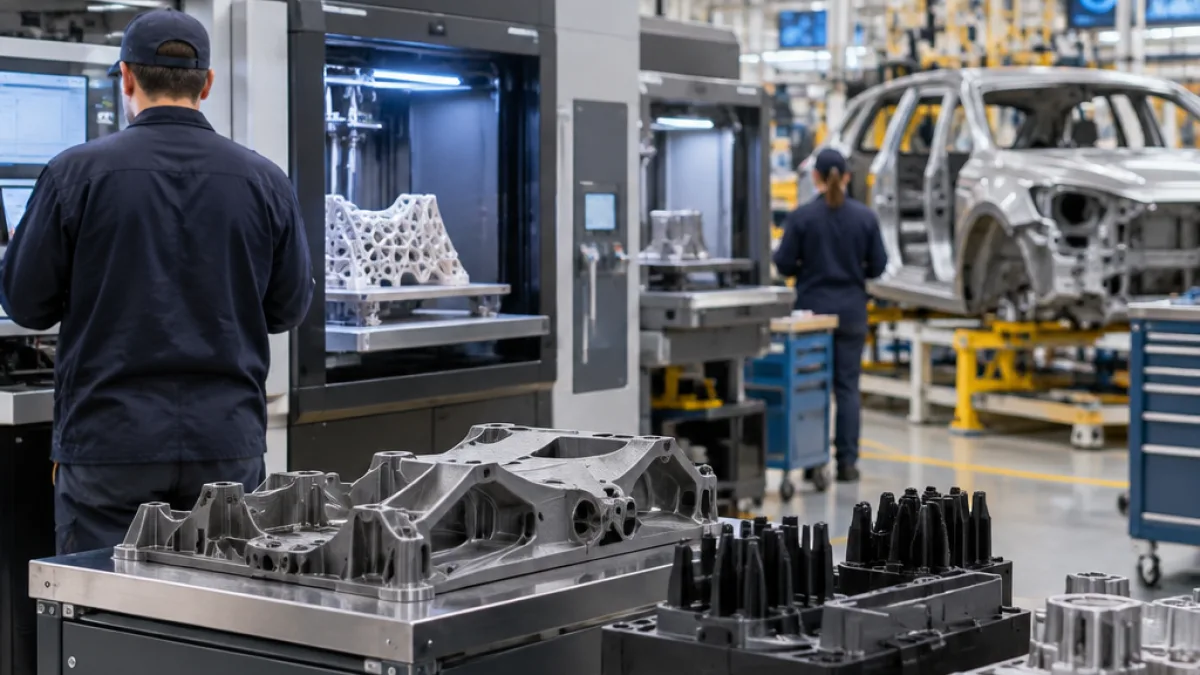
Rivian, Ford Motor and General Motors are expanding the use of 3D printing inside their U.S. manufacturing operations, bringing a technology once concentrated in design and engineering departments closer to factory production. The automakers are using additive manufacturing for tools, prototypes and selected vehicle components, with the aim of reducing delays, transportation needs and spending on conventional tooling.
Rivian targets broader factory use
Rivian has made additive manufacturing a company-wide manufacturing priority, according to Jared Beck, the electric vehicle maker’s head of additive manufacturing, who spoke to CNBC. The company has invested more than $5 million in 3D-printing equipment, while its yearly materials costs have reached about $1.7 million.
The machines build objects layer by layer from materials including plastics, resins, composites and metals. Rivian says equipment can replace parts of the traditional tooling and supply process: components that previously required weeks to source can be produced in days or, for less complex items, hours. The company is also adding equipment capable of making flexible silicone parts and intends to offer on-demand printing to workers at its manufacturing site in Normal, Illinois.
“The machines generally recover their costs within a year through lower tooling expenses, reduced logistics requirements and faster production cycles.” — Jared Beck, Rivian’s head of additive manufacturing, told CNBC
Ford builds a network of additive manufacturing sites
Ford is taking a facility-based approach, establishing dedicated additive manufacturing operations at several locations. Near its headquarters in Dearborn, Michigan, the company has introduced a vending-style system that provides 3D-printed tools used in production of the F-150.
Ford’s program includes more than 200 machines. The automaker expects to have 3D-printing laboratories at more than 23 plants by the end of 2026, according to CNBC. That rollout would make the equipment available across a broader portion of Ford’s manufacturing footprint rather than limiting it to specialized research and development functions.
- Rivian has invested more than $5 million in printing equipment.
- Rivian’s annual material expenses are approximately $1.7 million.
- Ford operates more than 200 machines and expects laboratories at more than 23 plants by the end of 2026.
- General Motors’ Cadillac CELESTIQ uses more than 130 additively manufactured components.
GM applies the technology to a luxury EV
General Motors is also using additive manufacturing outside its research and development work. Its Cadillac CELESTIQ luxury electric vehicle includes more than 130 components made through the process, demonstrating how the technology can be incorporated into a production vehicle rather than used only for development samples or factory aids.
The automakers’ efforts reflect a broader effort to bring manufacturing decisions closer to the plants where vehicles are assembled. Digital designs can be converted into physical tools or parts without waiting for an outside supplier to produce and ship them. The reported examples span factory equipment, prototypes and vehicle components, while the companies continue to invest in electric vehicles, digital infrastructure and new production methods.
For Rivian, Ford and GM, the approach is aimed at reducing the time between a design decision and a usable object on the factory floor. The companies’ reported deployments also show different applications for the technology: Rivian is expanding access across its operations, Ford is building a network of plant laboratories, and GM is incorporating additively manufactured parts into the Cadillac CELESTIQ.