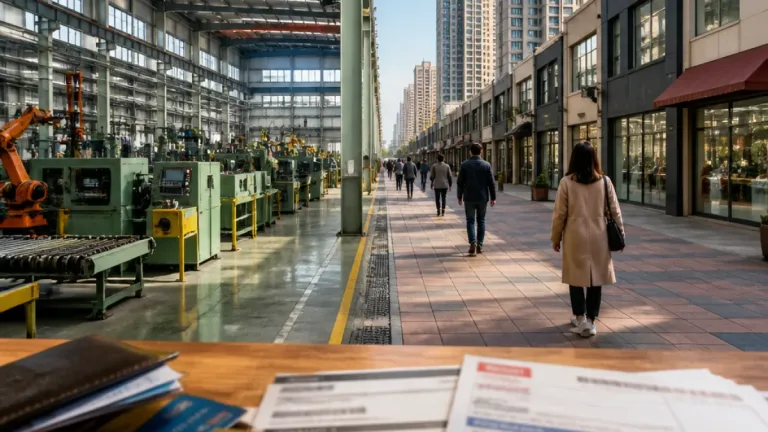

China’s manufacturing activity contracted in October as weaker domestic consumption and fading export orders put renewed pressure on the world’s second-largest economy, according to data released Saturday, October 31, by the National Bureau of Statistics.
The official manufacturing purchasing managers’ index fell to 49.3 from 50.1 in September. A reading below 50 indicates contraction, while a reading above 50 signals expansion. The result was also below the 50.0 median forecast in a Reuters poll of economists.
Domestic demand remains a central weakness
The October reading marked the sector’s third contraction in four months. New orders, including orders for export, remained below the 50-point threshold, while production and purchasing activity moved from expansion into contraction.
Reuters reported that factories were affected by a slowdown in overseas orders linked to the Christmas shopping season. Those orders had been brought forward into September, reducing activity in October. Domestic spending also lost momentum after an increase during China’s weeklong National Day holiday in the first week of the month.
“Insufficient demand is increasing downward pressure on the economy.”
Zhang Liqun, an analyst with the China Federation of Logistics & Purchasing, made that assessment after the figures were released. The data point to a difficult combination for policymakers: external shipments have supported industrial activity, but household spending has remained weak for an extended period.
Exports face a more difficult backdrop
China’s trade surplus with the rest of the world is on track to exceed $1.2 trillion, the level recorded last year, as exports have remained strong for much of 2026. October’s factory survey nevertheless showed that overseas demand may not provide enough support to offset sluggish consumption at home.
- The overall new-orders sub-index stayed in contraction territory.
- New export orders also remained below 50.
- Production and purchasing activity both declined from September.
- The non-manufacturing PMI, covering services and construction, fell to 49.7 from 50.2 in September.
Economists cited by Reuters said the export-led support could become less reliable if external demand deteriorates. Zhang Zhiwei, chief economist at Pinpoint Asset Management, said China would need stronger measures to stimulate domestic demand if overseas demand weakens in 2027.
“China will need more significant policy support to boost domestic demand.”
Economists call for broader support
Lu Zhe, chief economist at Soochow Securities, called for broader subsidies aimed at household and business financing. He said subsidies for mortgage-interest payments could help strengthen household confidence and stabilize sentiment. Lu also said subsidies for interest payments on loans supporting investment projects could ease the shortage of viable fixed-asset investments.
The recommendations reflect concern that weak consumer demand and limited investment opportunities are reinforcing each other. Factory activity is being tested by softer orders, while the property downturn and subdued household spending continue to constrain the domestic market. The October survey does not by itself establish the direction of the broader economy, but it adds to evidence that China’s industrial sector remains dependent on external demand at a time when trading conditions are becoming less certain.
The figures also come as China faces pressure from trading partners over the scale of its exports. Reuters reported that economists are urging additional domestic support because shipments abroad, despite their strength earlier in the year, may not be sufficient to compensate for prolonged weakness in consumer spending.