South Korean police have referred roughly 80 Tesla drivers to prosecutors after investigating the unauthorized activation of the company’s FSD feature on vehicles that had not received local certification for it. The Seoul Metropolitan Police Agency said it seized 21 bypass devices during the investigation.
The case centers on software modifications that investigators say affected vehicle operation. Police classified the alleged conduct as a violation of South Korea’s Motor Vehicle Management Act, which treats unauthorized changes to vehicle software linked to safe operation as a criminal matter.
Devices allegedly bypassed regional restrictions
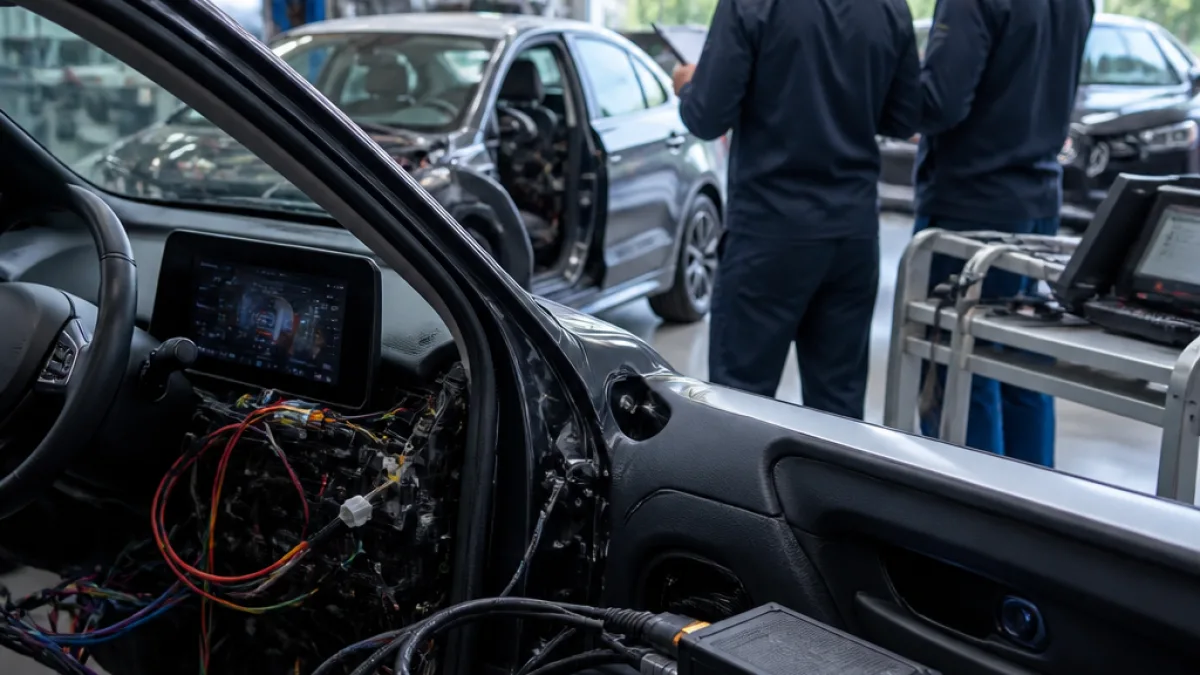
Investigators said the devices were imported from Europe and China, while at least one suspect built a unit at home using technical instructions available publicly. The equipment allegedly connected to the vehicles’ CAN bus, the internal communications network that carries commands between automotive systems, and was used to circumvent Tesla’s regional software controls.
Police also allege that some suspects exchanged information online about hiding activation records. The investigation is examining whether those methods were intended to keep Tesla or government authorities from detecting the unauthorized software access.
Certification differs by vehicle origin
South Korea’s restrictions do not apply in the same way to every Tesla vehicle. According to the police account, FSD has received safety certification in the country only for U.S.-built Model S, Model X and Cybertruck vehicles. China-built Model 3 and Model Y vehicles remain outside that approved group.
A partial exemption under the Korea-U.S. free trade agreement applies to certain vehicles built in the United States. That arrangement has created different software permissions for Tesla vehicles that may otherwise offer similar functions, depending on their production location and the certification status of the model.
| Vehicle category | Status described in the investigation |
|---|---|
| U.S.-built Model S, Model X and Cybertruck | FSD safety certification identified by police |
| China-built Model 3 and Model Y | Equivalent local certification not received |
Prosecutors will decide next steps
South Korean law allows for a maximum sentence of two years in prison or a fine of approximately 20 million won, roughly $15,000, for unauthorized vehicle software modifications. Those figures are statutory maximums rather than penalties already imposed in these cases.
The referrals do not establish that every driver will be charged or convicted. Prosecutors have not yet resolved the cases, and the final number of charges remains unclear. The investigation highlights the legal consequences that can arise when vehicle owners alter software controls governing features that regulators have not approved for a particular vehicle or market.
- Seoul police seized 21 devices and referred about 80 drivers.
- The alleged modifications connected to vehicles’ CAN bus and bypassed regional software controls.
- South Korean law provides for up to two years in prison or an approximately 20 million won fine.